
Investigating the CIP-FAST process with Titanium alloys
Manufacturing near-net shape components using solid-state processes to control the final geometry and microstructure
Cold Isostatic Pressing – Field Assisted Sintering Technology (CIP-FAST) is a novel two-step solid state processing route that can be used to produce complex geometries whilst allowing careful control of the microstructure. It finds most prevalence in expensive and difficult to machine materials such as titanium alloys, where there is a strong desire to reduce material wastage in manufacture.
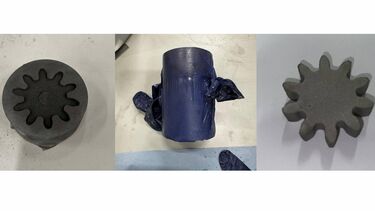
Previous work by Simon Graham, Yunus Azakli, Jonathan Withey and Martin Jackson explored the CIP-FAST process with commercially pure titanium and common titanium alloy Ti-64 powders to create complex geometries such as cogs and chess pieces.
The first step is the Cold Isostatic Pressing (CIP) of the powder in a silicon mould. 3D parts were designed using CAD software Fusion 360, and 3D printed. A two-part silicon resin was poured into a receptacle holding the 3D printed part. Once cured the 3D printed part was extracted, leaving a negative of the designed geometry in the silicon mould.
Hydride-dehydride (HDH) titanium powder was chosen for this experiment because of its inherent angular morphology. This allows the powder to lock together under pressure and maintain the geometry in the green body upon pressure release. It was poured into the mould, and a suitable silicon lid was used to contain the powder. The silicon mould was then placed inside a nitrile glove, and evacuated using a vacuum pump, before being sealed to retain the low pressure environment. The assembly was then placed inside the CIP machine, where a room-temperature water and oil mix was brought to and held at a pressure of 375MPa, densifying the titanium powder into a green body.
The green body was removed from the CIP machine and silicon mould, and placed within a cylindrical graphite mould. In the FAST process pressure is applied uniaxially, so to prevent the part from being flattened in the vertical Z direction, a secondary pressing media was used to aid pressing in the x and y axis. The pressing media chosen was ceramic powder ZrO2, as zirconium more readily reacts with oxygen than titanium, and should avoid forming an oxide surface on the part.
In the FAST machine a pulsed DC is applied in conjunction with pressure to sinter the powder into a solid piece. In conducting materials, current can pass through the powder particles, causing local heating and softening and leading to densification. With the use of ZrO2, the ceramic material insulates the titanium from the majority of the current, and heating is accomplished through conduction from the graphite, into the ceramic pressing media and finally the titanium material. This may lead to more microstructural variations due to the thermal gradients.
I have led recent work in the investigation of alternative feedstock material pressing media. Titanium aluminides present a challenge in manufacturing with their poor ductility and processability, but nonetheless exhibit attractive properties such as their low density. CIP-FAST offers a viable route to solid-state processing with reduced expensive and wasteful post-machining. I also investigated replacing ZrO2 with Tungsten as a pressing media to allow current to pass through the material; I found that the challenges faced in traditional titanium alloys were exacerbated in the titanium aluminide system. De-moulding the CIP’ed sample was more difficult due to greater impingement of the powder on the silicon mould. Additionally, major cracking and extensive porosity could be found in the final part. Investigations into the cause of these defects and possible solutions are presently ongoing, such as slowing the cooling rate from the FAST dwell temperature and including a lubricant between the silicon mould and feedstock.
Jack Krohn
EngD researcher, University of Sheffield
CIP-FAST allows solid state processing and therefore careful control of the part microstructure, whilst also allowing a high degree of creative freedom in the part geometry. These aspects make it a viable solution for manufacturing high-performance parts, where microstructural evolution is critical, and thus reduces the wasteful machining stages, mitigating costs. This process will most likely find most prevalence in the aerospace and performance automotive industry, where lightweight titanium alloys are an established material system.
Equipment Used
CIP: 3D printed part, silicon mould, feedstock material, CIP machine AIP3-12-60C
FAST: Graphite mould, rams, supports, graphite foil, pressing media ZrO2, FAST machine FCT HP D25

Biography
I am currently pursuing an EngD at the Advanced Metallic Systems Centre for Doctoral Training. My project focuses on the development of a powder-based solid-state manufacturing routes for titanium aluminide sheet with aeroengine-nacelle applications and is sponsored by Boeing UK.