Sustainability actions
Our Commitment
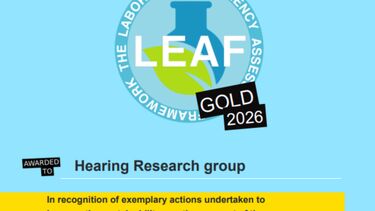
At the Sheffield Hearing Research group, our pursuit of groundbreaking discoveries goes hand-in-hand with our commitment to environmental stewardship. We are actively transforming our laboratory operations through a sustainable approach to research. By optimizing energy use, minimizing chemical and plastic waste, and implementing sustainable practices, our world-class research demonstrates that pioneering scientific excellence and environmental sustainability are fully compatible goals. Our effort has recently been rewarded with a Gold LEAF and Silver SPARKHub accreditations (see below).
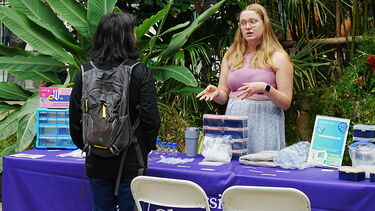
Communicating sustainability practises to the public through outreach activities
We aim to demonstrate to the public that cutting-edge biomedical research and environmental responsibility are deeply interconnected, while actively promoting a "green scientist" role-model image to the community.
This image shows our “The Green Lab” activity station during a recent outreach event (NeuroFest 2026), which was aimed at bringing brain science to the heart of Sheffield.
Some of the main actions taken
Energy Reduction
Laboratory equipment is highly resource-intensive, contributing substantially to a facility's total energy consumption and carbon emissions. This footprint is primarily driven by high-performance computers, specialized instrumentation, and ultra-low temperature (ULT) freezers that must run continuously. We reduce this footprint by implementing straightforward, actionable steps, including:
- Transitioning ULT freezers from -80°C to -70°C: this single adjustment reduces energy consumption by about 28% (University of Edinburgh study)
- Adjusting standard freezers from -20°C to -18°C: this saves roughly 4% energy consumption per freezer where sample types allow.
- Limit door opening: we map freezer contents and clearly label all items to reduce the time doors remain open.
- Utilizing visual reminders: we use posters and stickers to remind team members to turn off equipment and lights when not in use.
- Managing workstations: we ensure computers and monitors are not left running overnight.
- Maximizing equipment efficiency: we share hardware and utilize booking systems to optimize usage.
- Maintaining infrastructure: we schedule routine cleaning and maintenance of all laboratory equipment to ensure optimal operating efficiency.
Waste & Recycling
A major portion of a laboratory’s environmental footprint lies within its supply chain and waste management, with the procurement and disposal of single-use consumables driving significant indirect carbon emissions. We directly tackle this challenge by implementing strategies to lower the lifecycle carbon footprint of our research, including:
- Replacing single-use plastics: we substitute plastic items (e.g., Falcon tubes, stripettes, and plastic Pasteur pipettes) with reusable small glass bottles, Class A glass volumetric flasks, graduated cylinders, and glass Pasteur pipettes.
- Optimizing experimental protocols: we design procedures specifically to minimize plastic usage.
- Maximizing material lifecycles: when plastic items are necessary, we maximize their utility and reuse them whenever safely possible.
- Prioritizing green procurement: we purposefully select companies and products with verified ecological labels.
- Participating in circular economies: we actively adopt manufacturer take-back schemes for consumables.
- Conducting waste audits: we routinely monitor waste generation to identify areas for further reduction.
- Consolidating logistics: we order materials in bulk for the entire research group to significantly reduce transport packaging and shipping emissions.
For our work, we have been awarded gold LEAF and SPARKHub Silver accreditation: